

By Dustin Stone, RTN staff writer – 4.14.2026
Labor has become one of the most complex and least predictable variables in restaurant operations. Between fluctuating demand, staffing shortages, rising wages, and increasingly strict labor regulations, workforce management is no longer just an administrative function. It is a core operational challenge with direct impact on profitability. That’s the context behind the latest funding round for Nesto, a Germany company that has raised $12 million in growth equity funding from Expedition Growth Capital.
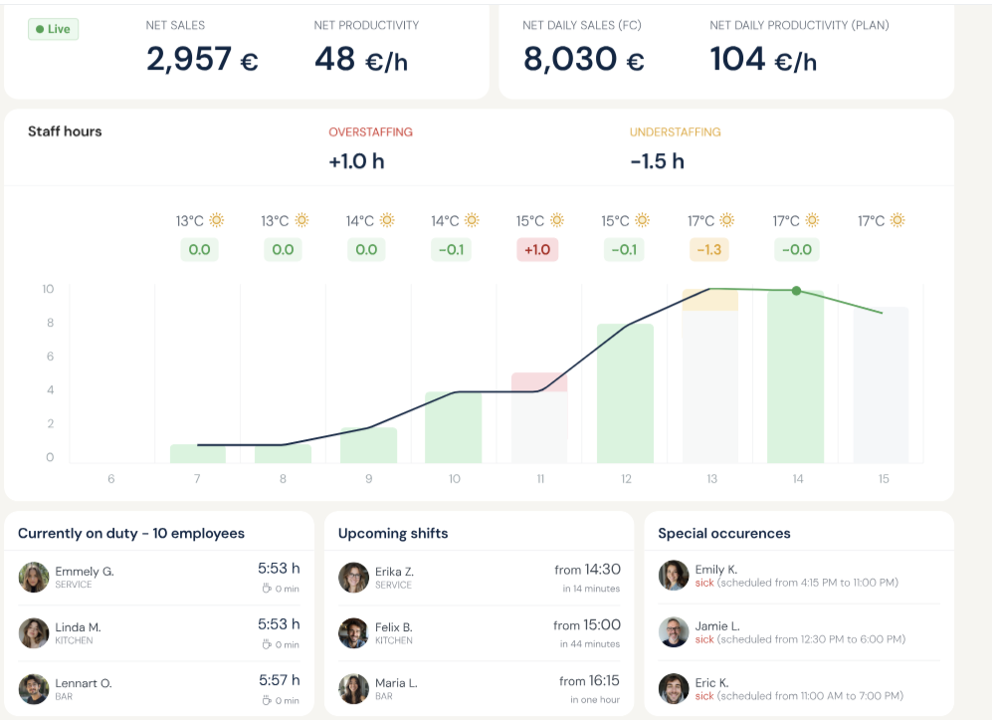
Founded in 2017 by engineers from the Karlsruhe Institute of Technology, Nesto has focused on a specific problem: aligning labor with demand in a way that is both efficient and operationally realistic. Its platform combines demand forecasting, shift planning, time tracking, and payroll into a single system, using AI to connect data points that are often managed separately.
At a functional level, the approach is straightforward. The platform analyzes historical sales data and combines it with external signals such as weather patterns, local events and seasonal trends. Based on that input, it generates staffing forecasts weeks in advance and translates those forecasts into shift schedules that account for employee availability, labor laws, and cost targets.
What distinguishes this from traditional scheduling tools is the level of automation. Instead of managers building schedules manually and adjusting them reactively, the system is designed to produce a baseline schedule automatically, with human oversight focused on refinement rather than construction. This is not a niche use case. Nesto reports that its platform is already deployed across more than 3,000 locations, with over 100,000 daily users ranging from independent operators to large chains. That level of adoption suggests that the demand for more structured, data-driven workforce planning is not limited to enterprise environments.
The company also reports measurable performance improvements, including productivity gains of more than 10%, reductions in planning time of up to 80%, and forecast accuracy approaching 90% under optimal conditions. While these figures depend on implementation quality and operational context, they point to a broader trend. Even incremental improvements in labor efficiency can have an outsized impact in an industry where margins are often tight.
The timing of the investment is notable. Across hospitality, operators are under pressure to do more with fewer resources. Staffing levels remain inconsistent, and turnover continues to be a challenge. At the same time, guest expectations around speed and service have not declined. This creates a need for systems that can help operators allocate labor more precisely, rather than simply reduce it.
Workforce management has historically been treated as a secondary system, often separate from revenue management, POS, and guest engagement platforms. That separation is becoming harder to maintain. Labor decisions are increasingly tied to demand signals, and those signals originate from across the business, including reservations, online ordering, and event bookings. This is where platforms like Nesto are gaining traction. By positioning workforce management as a data-driven function that sits closer to the core of operations, these systems are beginning to act as a coordination layer between revenue and execution.
The competitive landscape reflects this shift. Established workforce management providers such as UKG, ADP, and Ceridian have long offered scheduling and labor management capabilities, primarily focused on compliance, payroll and enterprise HR workflows. More recently, hospitality-specific platforms like 7shifts, HotSchedules and Deputy have gained traction by tailoring scheduling and communication tools to restaurant operations.
What distinguishes newer entrants like Nesto is their emphasis on AI-driven forecasting and automation as a core design principle rather than an add-on feature. Instead of focusing primarily on scheduling or compliance, these platforms aim to integrate demand signals, labor planning, and execution into a more unified system. That positioning places them somewhere between traditional workforce management tools and broader operational platforms, with the potential to influence how labor decisions are made across the business.
There is also a practical benefit in consolidation. Many restaurants still rely on a mix of tools for scheduling, time tracking, and payroll, often requiring manual reconciliation between systems. Bringing those functions together into a single platform reduces administrative overhead and improves data consistency. For operators, that can translate into better visibility and fewer operational gaps.
Nesto’s roadmap reflects this shift. The company plans to use the new funding to expand its AI capabilities, strengthen its data infrastructure, and accelerate international growth. The broader goal is to position its platform not just as a scheduling tool, but as a more comprehensive operating system for workforce management.
That ambition aligns with a wider movement in hospitality technology. Systems that were once focused on individual tasks are evolving into more integrated platforms that handle multiple aspects of the operation. The advantage is not just efficiency, but the ability to make more coordinated decisions across the business.
At the same time, there are limits to what technology alone can solve. Workforce planning is inherently tied to human factors, including employee preferences, local labor conditions, and management practices. AI can improve forecasting and reduce manual work, but it still relies on accurate data and thoughtful implementation.
For operators, the challenge is to integrate these tools into existing workflows without adding complexity. The most effective deployments tend to be those where the system supports decision-making without replacing it entirely. The investment in Nesto suggests that investors see workforce management as an area where that balance is achievable. The combination of clear operational need, measurable ROI, and increasing data availability makes it a logical focus for further development.
As the hospitality industry continues to adapt to a more volatile operating environment, the ability to align staffing with demand in a consistent and scalable way is likely to become more important. Platforms that can translate data into practical scheduling decisions are well positioned to play a larger role. Nesto’s latest funding round does not redefine the category, but it does reinforce its direction. Workforce management is moving closer to the center of restaurant operations, and systems that can support that shift are attracting increasing attention from both operators and investors.