
Oil prices dropped on Sunday after President Donald Trump said an agreement with Iran had been reached and the United States would end its naval blockade on the country.
Brent crude prices on Sunday fell 3.9% to about $84 a barrel, and US crude dropped 4.8% to about $81 a barrel. If oil settles at that level, it will be the lowest price for crude since March 4, just a few days into the war.
Anticipating a deal framework to be reached this weekend, oil settled below $90 a barrel on Friday for the first time since the first week of the war. Still, it has a long way to go to get back under $70, where it was before the United States and Israel launched attacks on Iran in late February.
Markets have cheered apparent progress, but the oil market still has significant work ahead to return the flow of crude to normal. The Strait of Hormuz needs to be de-mined, ships need to be able to freely flow in and out of the strait, Middle East production needs to come back online, emergency petroleum reserves need to be refilled, and damaged energy facilities need to be repaired.
Oil analysts widely believe oil prices will remain elevated for quite some time. Even though prices may fall initially, they’re widely expected to bounce back once demand rises again — and particularly when emergency stockpiles get refilled.
Trump posted late Sunday afternoon on social media that a deal with Iran “is now complete.” Iran also affirmed on Sunday evening that the memorandum of agreement was finalized with the US, adding that it is expected to be signed on Friday in Switzerland.
Both Trump and Iran’s deputy foreign minister for legal and international affairs signaled that the US blockade of Iran’s ports will be removed. Trump also said mines will need to be removed from the Strait of Hormuz, a crucial waterway for global oil supply.
Trump added that he authorized “the toll free opening of the Strait of Hormuz.” Some ships have been charged about $2 million on average for passage, according to a member of Iran’s parliament.
But even once the strait is reopened, it will take time to fully resume trade. Middle Eastern oil wells were largely shut off during the war and could take weeks to ramp up production when turned back on. Experts also warn that the wells may not be capable of pre-war production levels.
Prices may surge if the disruption is prolonged and shock absorbers, such as the US Strategic Petroleum Reserve, are depleted, Bob McNally, president of Rapidan Energy, said Sunday on ABC’s “This Week.”
“I’m very concerned we could see oil prices skyrocket later this summer with crude oil prices heading well into the mid- to high-$100 range, and gasoline pump prices heading back to all-time highs around $5 a gallon,” he said.
And markets could remain skeptical that the strait has re-opened until ships start to transit regularly and safely.
“it’s great if it happens but I’ll believe it when I see actual ships making the free and unhindered passage through the strait,” said Joe McMonigle, president of think tank Global Center for Energy Analysis and who lives in Saudi Arabia.
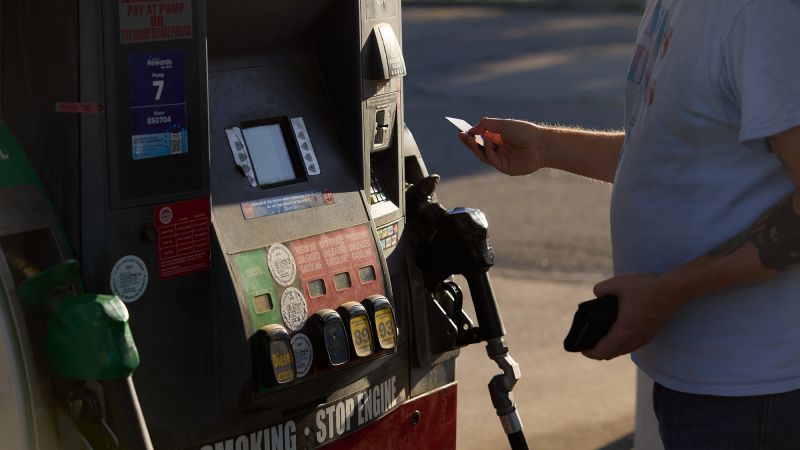
The average price of gas in the US settled at $4.07 a gallon on Sunday, according to AAA. Gas prices have declined for three straight weeks, but are still about 36.6% higher than before the war began.
Stock futures, meanwhile, climbed on Sunday. Dow futures gained 0.6%, while S&P 500 and Nasdaq futures were each up more than 0.7%.
CNN’s Matt Egan contributed reporting.