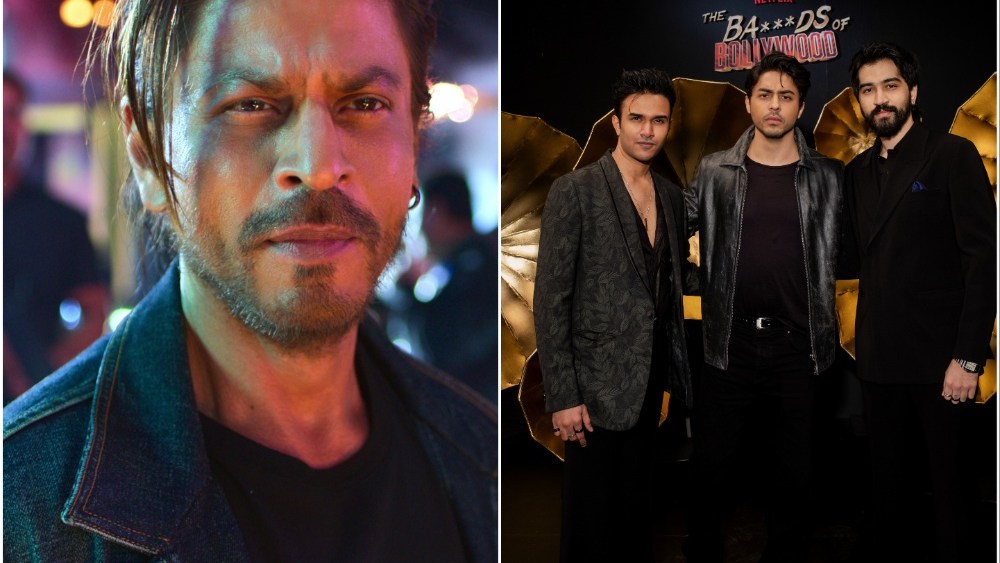
Aryan Khan has spent his entire life in the public eye, but for his professional debut, he’s chosen to work behind the camera rather than in front of it.
“The Ba***ds of Bollywood,” his seven-episode directorial debut for Netflix, is an energetic and boldly entertaining series that offers a frank look at nepotism, ambition and betrayal within India’s Hindi-language film industry.
Produced by his parents Bollywood superstar Shah Rukh Khan and Gauri Khan’s Red Chillies Entertainment, the series centers on Aasmaan Singh (Lakshya), a young actor chasing stardom alongside his best friend Parvaiz (Raghav Juyal) and manager Sanya (Anya Singh). His family — uncle Avtar (Manoj Pahwa), mother Neeta Singh (Mona Singh), and father Rajat Singh (Vijayant Kohli) — provide support as he enters the industry. When Aasmaan lands a role opposite Karishma (Sahher Bambba), the daughter of established star Ajay Talvar (Bobby Deol), tensions escalate. Producer Freddy Sodawallah (Manish Chaudhari) and former star Jaraj Saxena (Rajat Bedi) add to the industry intrigue in this self-aware look at Hindi cinema.
The show has already made an impact, landing in Netflix’s global top 10 for non-English content and reaching No. 1 in South Asia.
“Ever since I was a kid, I’ve preferred telling stories,” Khan tells Variety. “I always felt I had a lot of things to say, and I just feel I could tell it in a different and an interesting way. I just felt there’s more control behind the camera. And, it’s simply you enjoy it more. It’s something you love more. And I feel if you do something that you love, you always do a better job. And it stops being a job after a point, you look forward to it every day, and it’s what you want to do.”
Khan’s passion for filmmaking was nurtured early by his father. “My father himself is extremely in depth about the aspects of filmmaking, whether it is VFX, whether it is lighting, camera work, whatever. And ever since I was a kid, he would show me this – ‘You don’t actually get shot. This is how it happens.’ Or, how do you make a plane fly through the sky without actually making a plane fly? And all of that was, obviously, it’s like magic to a child,” he recalls. By age 10 or 11, Khan was doing VFX on iMovie and editing on Final Cut Pro.
The series reunites Khan and his long-time collaborators, writers Bilal Siddiqi (whose previous work includes Netflix’s “Bard of Blood”) and Manav Chauhan. “Manav and Bilal and I have been making movies since we were 13 or 14 together,” Khan says. The trio created short films and experimented with storytelling, with their biggest early project being a 21-minute superhero web series pilot. “We made at least 15 to 20 films together, short ones for different people, also for people trying to apply to film schools, for people who wanted to act,” Khan recalls.
During COVID-19 lockdown, they continued their creative collaboration. “We wrote one during lockdown as well, which we just shot at home because we had two years of not much to do. And we shot it with my sister [“The Archies” star Suhana Khan] and my dad, and I was just the DOP on that one,” Khan says. “So that’s how we actually got started. We were just jamming on multiple different things, thinking of storylines, plots, and we thought we should do it properly, and do it on a larger scale.”
Chauhan, who has worked on films including “Raees” (a Shah Rukh Khan film) and “Tenet,” adds: “We used to make short films together, all of us, so we used to kind of just take a camera, take a phone, and just experiment, and we used to act in it also, we used to direct it also, we used to do everything by ourselves. Aryan being such a great dialogue writer, I’m not a very profound writer as such, but I can entertain. I know that much I can create good shots. So Aryan was mostly into the writing aspect of it, and then eventually he started directing.”

Lakshya, Sahher Bambba – “The Ba***ds of Bollywood”
Netflix
What sets “The Ba***ds of Bollywood” apart is its refusal to be pinned down to a single genre. “It’s not a traditional form of comedy. It’s not a sitcom,” says Siddiqi. “Our show is juggling a lot of balls. The genre — even when we three sit down now, we kind of find it difficult to define that. But what this allows us to do is… you can’t say things very well in a defined structure of a spy film or action film or whatever that has well-established archetypes. So I think we had a lot of fun with it. We didn’t allow ourselves to get tied down in just one thing. We knew that we have an overarching dramatic arc that we have to follow, but within that, we just had these interesting characters with which we could really go crazy.”
Khan elaborates on how this genre flexibility serves the storytelling: “We can do an action sequence. We can suddenly break your heart by showing a death and then suddenly become a rom-com, you can suddenly become different because there are so many different [genres] and that’s also because of the length that we have.”
He continues: “The first three episodes are light-hearted, slowly build into the sadness. We built all the characters in the earlier phases. Now we make you feel bad for them, and since the arcs are all defined, we go into a climax that is more rewarding, as you now have stakes for every character. And these are all things from different genres. So it becomes very interesting. We can almost say anything from any genre. Since we are making a TV show about the film industry, we can say anything in this genre that we have.”
The decision to have Khan direct all seven episodes, rather than splitting duties among multiple directors as is common with streaming series, was a crucial creative choice. Siddiqi notes that this was a significant undertaking: “It was a very big step to take on seven episodes worth of content — just to ensure that the tone that we envisioned makes it to screen in the way we intended. It was a very interesting and big decision for him as an individual and us.”
Chauhan points to specific examples of how Khan’s consistent direction paid off: “The setup and payoffs are such that everything that is there as a setup, like the Emraan Hashmi thing [Bollywood star Hashmi appearing as himself] happening in the start in the first episode itself, and then the payoff happening at the third episode — it’s so nuanced to the tone that I think only Aryan would have had that unique way of telling that in that certain sense.”
The series, with various luminaries playing themselves in cameos – including Hashmi, Shah Rukh Khan, Aamir Khan, Salman Khan, Karan Johar and S.S. Rajamouli – takes a sharp look at industry dynamics, but Aryan Khan is careful to note the balance they struck. When asked how close to the bone the show cuts with its themes of nepotism, ambition and betrayal, Khan reflects: “What is interesting about the show is — in Bollywood, there’s many truths, many lies, that kind of are disguised.. and vice versa, and it’s just the novelty of the mystery or the wonder that entices audiences to watch. People will be fascinated by it, be annoyed by it, be whatever they want because of the largeness and the mystery and the wonder.”
He continues: “We were pushing it for screen, obviously, but obviously there’ll be things that are inspired. There’ll be scenes that are inspired on certain realities, and there’ll be exaggerations. It’s not obviously a documentary.”
S.S. Rajamouli, Aamir Khan – “The Ba***ds of Bollywood”
Netflix
Regarding creative boundaries, Khan says the team set their own parameters. “We wanted to be self-deprecating, but not disrespectful anywhere. So I think we maintained that line correctly, and the guardrails were self-imposed, mostly because, making something about the industry and being a part of the industry, there has to be — there is a lot of respect. People being able to take jokes on themselves, I feel, is the first and most important thing about comedy. Take a joke on yourself and then spread the love. People were extremely sporting, and we also made an effort not to push boundaries in terms of being disrespectful, only being self-deprecating.”
Khan also discusses the tonal limits they established internally: “We had other guardrails about the tone. Are we that show which goes into constantly spoofy slapstick genre? Perhaps not. Do we have spoofy and slapstick moments? Yes. Do we have over-the-top action moments? Yes. But is that serious or is that a joke? It’s bending many genres and merging many things. But there was definitely a guardrail in my head when it came to we can’t keep pushing the thing to a certain level where it becomes too spoofy. You can’t become an ‘Austin Powers’ suddenly.”
He adds: “The story of the show is, in its essence, a family drama, and you’re supposed to feel the emotion of everyone involved. For that to happen, the guardrails were set tightly, but [we] also figured out along the way of where to push.”
Siddiqi emphasizes that creative decisions were driven by instinct and extensive discussion rather than external limitations. “The three of us spent so much time writing it, we just instinctively felt that some things while in discussion probably didn’t fit our show, so we discussed it to the fullest and then left it aside. Or some things instinctively felt right on the first go, so we incorporated that. So there were no guardrails externally put on us. It was just us discussing things that were best for the story we wanted to tell. The tropes that we used, we were quite clear at some level we wanted to subvert them. So we subverted the classical Bollywood rom-com in a certain sense.”
Khan acknowledges they did face some resistance during later stages of production: “We did get some notes on certain scenes where they were like, ‘Oh, this is too this, or this is too that,’ but then I took a stand. If you don’t like it, I mean, the show is not meant for you, or it is meant for you but you might not like it, your 18-year-old kid might like it. Your uncle might like it who likes certain kinds of humor or certain kinds of jokes.”
For Khan, the heart of the show has always been its characters, which he believes distinguishes it from other series. “Touchwood, the heart of the show has always been the characters. And the entire idea when making the show, why we wanted to go into longer format, is to do these characters justice and create characters that you can take home with you,” he says, comparing it to how “Friends” became part of the cultural lexicon. “It makes a household name, and you repeat the dialogues.”