Apple lifted the curtain on this year’s iPhone 17 models, including what it touted as the thinnest-ever smartphone the company has ever made, the iPhone Air. Overall, the new models are more powerful and durable, according to Apple — and while some analysts expected the tech giant to hike prices, the new models are mostly priced in line with the prior-generation iPhone 16s.
The Sept. 9 event, promoted with the tagline “Awe Dropping,” is the tech colossus’ biggest product launch of the year, timed to get units into the retail pipeline ahead of the holiday shopping season.
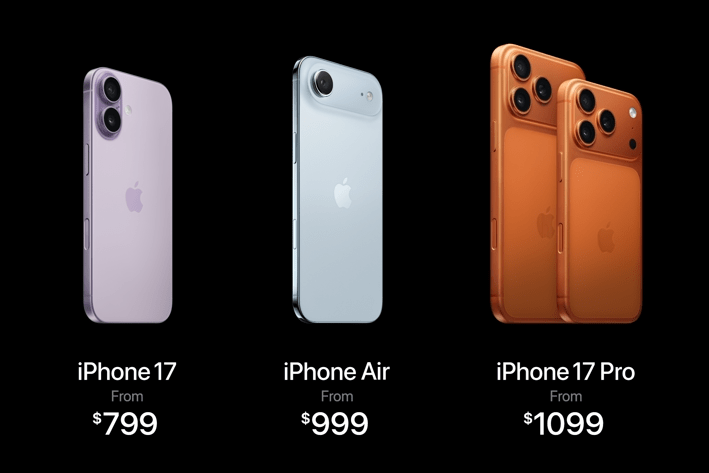
Apple introduced four new smartphones: iPhone 17, iPhone 17 Pro, iPhone 17 Pro Max and the iPhone Air. The Air, starting at $999, has an ultrathin design that is just 5.6 millimeters thick, about 28% thinner than the standard iPhone 16.
The tradeoffs for the Air, which has a 6.55-inch screen, include a relatively shorter battery life, a single rear-facing camera (although Apple says the 48-megapixel camera enables the equivalent of four lenses) and no support for physical SIM cards (requiring a virtual eSIM). That said, Apple claims the iPhone Air provides “all-day” battery life with up to 22 hours of streaming video playback.
The iPhone Air is a “game-changer” that provides “pro performance in an unbelievably thin and light design,” Apple chief Tim Cook said in a recorded video shown during the presentation.
The iPhone 17s include a baseline of 256 gigabytes of memory, up from 128 GB for the iPhone 16, yet they are for the most part keeping the same starting price points. The baseline iPhone 17, with a 6.27-inch screen, starts at $799 with 256 GB of memory, the same price as the iPhone 16 with half the memory. The iPhone 17 Pro, which also has a 6.27-inch screen, starts at $1,099 (up $100 from the 16 Pro) and the 17 Pro Max, with a 6.85-inch screen, starts at $1,199.
For comparison, the list prices for the iPhone 16 models introduced a year ago with 128 GB of memory were $799 (iPhone 16), $899 (16 Plus), $999 (iPhone 16 Pro) and $1,199 (iPhone 16 Pro Max). Those price points were mostly in line with those of the iPhone 15 family launched in 2023.
Preorders for the iPhone 17 and iPhone Air begin Friday, Sept. 12, with availability beginning Friday, Sept. 19. The iPhone 17s will be available in five colors (black, lavender, mist blue, sage and white) and iPhone Air will be available in four finishes (space black, cloud white, light gold and sky blue).
This year, Apple has faced higher costs because of President Trump’s tariffs on countries including China and India. The company reported $800 million in tariff-related costs in the June 2025 quarter and expects about $1.1 billion in tariff expenses for the September quarter.
As for AI, Apple said that iOS 26, the next generation of its iPhone operating system, augments Apple Intelligence’s feature set to now be able to translate text and audio with Live Translation, helping users communicate across languages in Messages, FaceTime, and phone calls. The iOS 26 update features Apple’s Liquid Glass, which makes certain interface elements appear as if they’re composed of actual glass.
Apple said the iPhone 17 line introduces Ceramic Shield 2 with a new coating for “3x better scratch resistance” and improved anti-reflection to reduce glare.
The iPhone 17 features Apple’s A19, a six-core central processing unit that the company said is more than twice as fast as the A15 Bionic chip. The A19 Pro, which powers the iPhone Air, iPhone 17 Pro and iPhone 17 Pro Max, delivers up to 40% better sustained performance than the previous generation, according to Apple.
The latest iPhone models introduce the new Center Stage front camera. With the feature, users no longer have to rotate their iPhone to take a landscape selfie: You can now take photos and videos in portrait or landscape while holding your iPhone vertically.
In addition, Apple said eSIM-only models of the iPhone 17, iPhone 17 Pro and iPhone 17 Pro Max will be available in the U.S., Canada, Japan, Mexico, and select other countries.
Alongside the iPhone 17 lineup, Apple announced products including AirPods Pro 3 ($249) with active noise cancellation, 8-hour battery life and a live-translation feature; the Apple Watch SE (starting at $249); and the sports-focused Apple Watch Ultra 3 ($799 and up).