While a picture may be “worth a thousand words,” it undoubtedly contains millions of pixels, the name that has been given to the smallest element in an image. At a baseline, they contain the color and brightness of a specific point in a picture, and the more there are, the clearer an image becomes. Beyond the reason that a picture would not be able to exist without pixels, they are becoming increasingly useful for ecological studies. Thanks to the help of drone sensor technology, a wide range of information can be stored within a pixel. For example, drones can pick up on the same features we use to identify plants, such as their size, shape, and color- plus more!
The colors the human eye sees fall within the visible light spectrum, which ranges from about 380-750 nanometers (nm). Drones, however, depending on the type of sensor they are equipped with, can see well beyond this range and capture wavelengths that are invisible to us. Certain multispectral sensors capture 5 bands including the visible red, blue, and green, plus red-edge (705-729nm) and near-infrared (785-899nm). Some hyperspectral sensors capture an incredible 340 bands, spanning 400-1000nm.
You might be thinking, how is this information useful? Both plants and animals emit these forms of radiation, and sometimes, when looking at images at these other wavelengths, they can become more detectable. While the incorporation of drone technology in ecological studies has greatly advanced the way scientists study ecosystems and their organisms, there is still a lot to learn about which methods are best to use and how it can identify species at a proficient level.
A team of researchers at Archbold Biological Station are using drone technology to study methods of detecting shrubs on grazing lands, known as woody encroachment, at its Reserve and Buck Island Ranch. Grasslands with woody encroachment are considered to be in a transitional state, where they will slowly change into shrublands or woodlands if not managed, and in Florida, woody encroachment affects cattle grazing habitats including semi-native pastures, wet and dry prairies, wetlands, and different types of scrub habitat.
Encroaching brush species include both native and non-native species from surrounding forests or scrub. Common encroachers from nearby wet habitats are the highly invasive Brazilian peppertree and Peruvian primrose, along with native saltbush, wax myrtle, and Carolina willow. Additionally, sand live oak and sand pine oak tend to encroach on upland, yellow sand oak scrub.
Dr. Aaron David, Archbold’s director of Plant Ecology and lead researcher of the projects, said, “Early detection and gauging the extent of woody encroachment can be incredibly challenging, and thus, drone flights may be helpful for locating, quantifying, and identifying encroachment before the problem gets worse.”
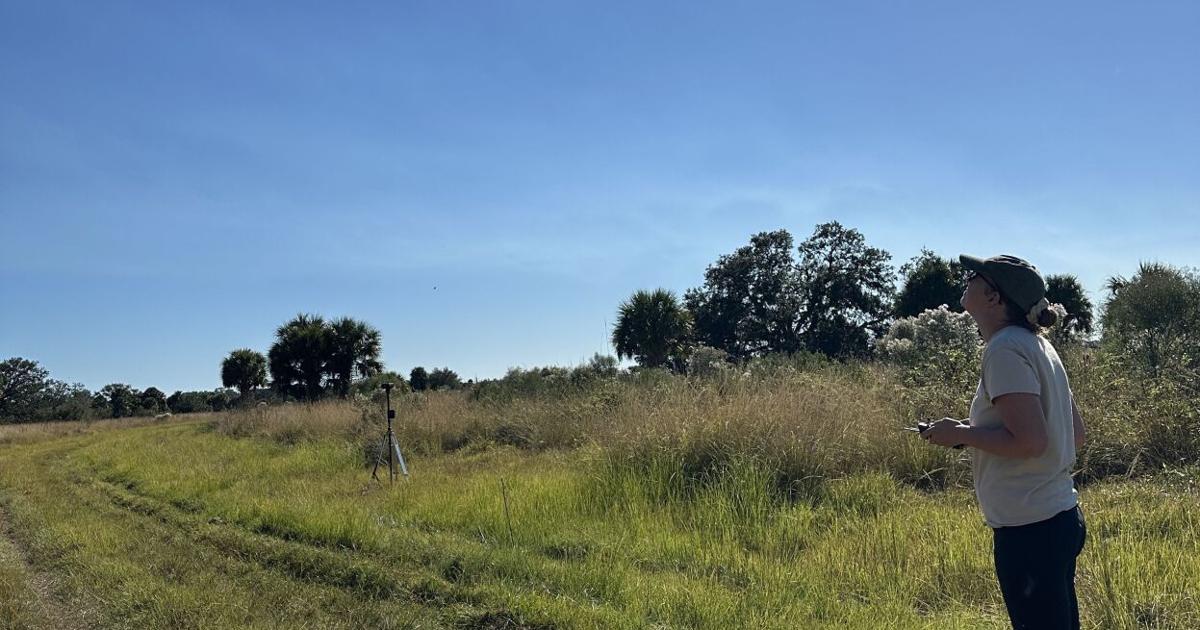
One researcher on the team, Allison Schumacher, GIS research assistant and drone pilot, has performed drone flights over seven different management units with four different sensors, including the two discussed above (multispectral and hyperspectral) as well as RGB which captures images in red, green, and blue color channels and LIDAR, which measures distances and creates 3D models of the environment. Members of the Plant Ecology and Agroecology Programs assist Schumacher out with another important component of the project: plant identification.
According to Plant Ecology Intern Jenna Baljunas, “We established test plots and documented all the plants they contain, whether they are woody encroachers or not, using an extremely accurate GPS unit. Later, we’ll fly the drone over these areas to capture images of these species with our different sensors.”
Currently, the team is in the testing phase of the project to see how well their models can predict woody encroaching species.
Baljunas says, “although on the ground studies are imperative for ecological knowledge, learning to use technology now can help us study across a much broader scale and complete more accurate assessments in a quicker amount of time.” She adds, “I find that technology has already fostered so much more creativity in the field of ecology because it quite literally changes your perspective on what’s around us.”




https://shorturl.fm/A5ni8
https://shorturl.fm/oYjg5
Positive user experiences on Escorttime reflect the platform’s dedication to providing reliable female escort and erotic massage listings in major US cities. The structured layout and simple search tools make navigation effortless. Those reviewing Escorts in Los Angeles frequently praise the variety and professional presentation of profiles. Service providers appreciate the transparent pricing and supportive promotional environment. Escorttime’s steady growth is fueled by consistent client and provider satisfaction.
Many clients express appreciation for Bedpage’s consistent commitment to clarity and ease of use. The well-organized categories allow visitors to navigate confidently and identify suitable services quickly. Whether planning a relaxing erotic massage session or meeting a respectful female escort, the platform promotes professional interaction. In cities like Escorts in Miami, authentic reviews and structured listings reinforce trust, helping users feel secure while arranging meaningful connections.