
By Dustin Stone, HTN staff writer – 5.7.2026
As generative AI rapidly reshapes how travelers research, compare, and book accommodations, hotel companies are increasingly racing to establish visibility inside the conversational platforms that may soon rival traditional search engines and online travel agencies as primary discovery channels.
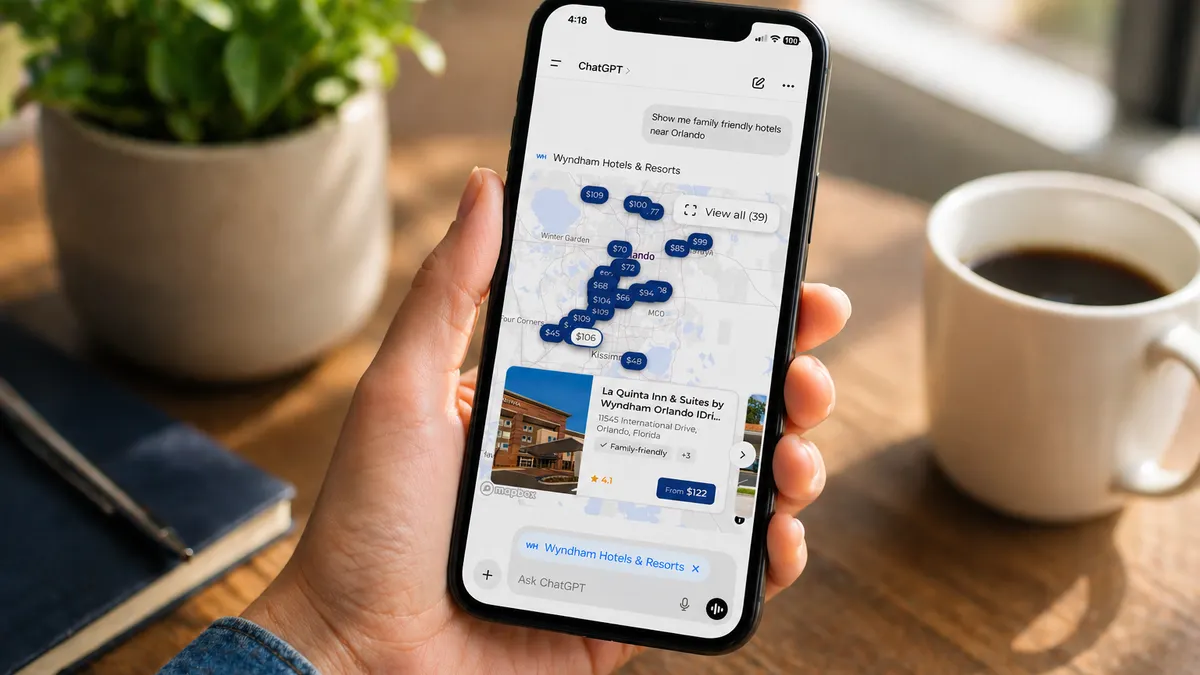
Wyndham Hotels & Resorts is the latest major brand to make a significant move in that direction, launching a native app within ChatGPT designed to help travelers search and discover hotels conversationally while creating a direct path to booking.
The launch marks what Wyndham describes as the first native hotel app from a major U.S. economy and midscale franchisor available inside OpenAI’s ChatGPT ecosystem. More importantly, it signals how aggressively hotel companies are beginning to position themselves for a future in which AI assistants increasingly influence travel planning, hotel selection, and purchase decisions.
The new experience allows users to explore Wyndham’s portfolio of approximately 8,400 hotels worldwide directly within ChatGPT through map-based browsing, conversational prompts, amenity filters, and interactive hotel cards. Travelers can refine searches using natural language rather than traditional keyword queries before seamlessly transitioning to WyndhamHotels.com to complete bookings.
While the consumer-facing functionality may appear relatively straightforward on the surface, the broader strategic implications are far more significant.
For decades, hotel distribution has largely revolved around search engines, OTAs, brand websites, loyalty ecosystems, and metasearch platforms. Conversational AI introduces an entirely new layer between traveler intent and hotel discovery. As platforms such as ChatGPT, Claude, Gemini, and Perplexity become more deeply integrated into consumer behavior, hotel companies increasingly risk losing visibility if their inventory and brand experiences are not optimized for AI-driven discovery.
Wyndham appears to recognize that risk earlier than many of its competitors. The company’s ChatGPT launch represents its second major large language model integration in less than two years. In 2025, Wyndham became the first major hotel company to launch on Anthropic’s Claude platform, and the company says it is already preparing an additional integration with Google’s AI Mode. Collectively, those moves suggest Wyndham is not viewing AI as a standalone feature or marketing experiment, but rather as a long-term distribution and engagement strategy.
That approach differs somewhat from how many hotel brands initially approached generative AI during the first wave of experimentation in 2023 and 2024. Early deployments often focused on isolated use cases such as chatbot customer service, automated content generation, or internal productivity tools. Increasingly, however, the industry is beginning to recognize that conversational AI may fundamentally alter how travel demand is captured and directed. Wyndham’s broader technology investments help explain why the company may be better positioned than some competitors to move quickly.
Since 2018, Wyndham has invested more than $450 million in technology modernization. In 2020, it became the first major hotel company to fully migrate its systems to the cloud, creating a more flexible infrastructure for integrating AI capabilities across both consumer-facing and operational systems. That architecture relies heavily on partnerships with major technology providers including Oracle Hospitality, Amazon Web Services, Adobe, Salesforce, and Aven Hospitality, formerly Sabre Hospitality Solutions.
Those investments are now beginning to produce measurable operational outcomes beyond guest-facing discovery. According to Wyndham, AI-powered tools deployed within its call centers have reduced average handle times by 7% while simultaneously improving agent training and conversion performance. The company is also extending AI deeper into property-level operations through Wyndham Connect and Wyndham Connect PLUS, its Canary-powered guest engagement platforms that provide opt-in automation tools for franchisees.
The platforms support AI-driven messaging, operational automation, guest engagement, upselling, and direct booking initiatives. Wyndham says the most engaged hotels using the platform averaged more than $60,000 in incremental revenue last year, while the highest-performing property exceeded $200,000 in incremental revenue. Those metrics are particularly important because they address one of the hotel industry’s biggest ongoing AI questions: whether the technology can generate measurable owner ROI rather than simply incremental convenience.
For franchisors such as Wyndham, demonstrating direct owner value is critical. Unlike many luxury operators that control large portions of their real estate or management structures, franchise-heavy hotel companies must continuously justify technology investments to independently owned properties focused heavily on cost control and operational efficiency.
Michael Mahar, Wyndham’s senior vice president and head of commercial technology, framed the company’s AI strategy around that owner-centric philosophy. “As AI becomes central to how travel is planned and purchased, our focus is on translating innovation into real results for owners,” he said in announcing the launch.
The competitive landscape surrounding hotel AI has become increasingly crowded over the last 18 months. Earlier this year, Hilton Worldwide introduced a generative AI-powered digital concierge designed to help travelers plan trips and navigate hotel experiences. Marriott International CEO Anthony Capuano recently confirmed that Marriott is preparing to launch a natural-language search experience on Marriott’s website as part of the company’s broader AI strategy.
Meanwhile, Choice Hotels International has taken a more operationally focused approach through its expanding partnership with AWS. Choice recently unveiled a wide range of AI-driven tools including Business Direct, EasyBid, CHARLIE, and RAISE, targeting everything from SMB booking workflows and group RFP management to staff support and revenue optimization.
Other hotel companies are quietly experimenting with similar technologies behind the scenes, even if they have not yet publicly rolled out large-scale consumer AI initiatives. Across the sector, executives are increasingly evaluating how conversational AI could influence distribution economics, loyalty engagement, staffing efficiency, guest personalization, and search visibility. At the same time, hotel companies face growing uncertainty around how AI intermediaries may ultimately impact brand control and customer ownership.
Historically, hotel brands have fought aggressively to drive direct bookings and reduce dependence on OTAs such as Booking.com and Expedia Group. AI assistants could potentially create a new intermediary layer that influences traveler decisions before guests ever reach a hotel website. If conversational platforms become the dominant gateway for travel planning, hotel companies may eventually find themselves competing for algorithmic visibility in ways that resemble today’s search engine optimization battles.
That possibility helps explain Wyndham’s aggressive push into multiple AI ecosystems early. By embedding its inventory and discovery tools directly into conversational interfaces, Wyndham is effectively attempting to secure relevance before traveler habits fully shift. The company is betting that future hotel shopping behavior may become far more conversational, contextual, and AI-assisted than the traditional search-and-filter workflows travelers use today.
Industry analysts increasingly believe that shift could materially alter the balance of power between hotel brands and intermediaries. A recent academic study examining AI-powered hotel search behavior found that conversational discovery platforms may redistribute traffic away from traditional OTA-heavy ecosystems and toward brands capable of surfacing richer contextual and experiential information directly inside AI search environments. That possibility has major implications for hotel marketing and digital commerce strategies.
If AI-powered discovery engines increasingly synthesize recommendations directly rather than simply displaying ranked search links, hotel companies may need to rethink everything from content strategy and loyalty positioning to API connectivity and metadata optimization. Visibility inside LLM ecosystems could become just as strategically important as search engine rankings became during the early Google era. Wyndham’s early integrations with ChatGPT, Claude, and Google AI Mode suggest the company understands that emerging dynamic.
There are still many unanswered questions surrounding how AI-powered travel discovery will evolve. Monetization models, advertising structures, ranking algorithms, booking attribution, and customer ownership rules remain highly fluid. Consumer adoption patterns are also still developing, particularly among mainstream hotel travelers outside early-adopter technology audiences. Nevertheless, the broader direction of travel appears increasingly clear.
Hotel companies are no longer simply experimenting with AI productivity tools. They are beginning to redesign how guests discover properties, how owners operate hotels, and how brands compete for digital visibility in an increasingly AI-mediated travel ecosystem. Wyndham’s ChatGPT integration may ultimately prove less important for its immediate booking impact than for what it signals strategically: conversational AI is rapidly becoming a new battleground for hotel distribution, guest engagement and franchise performance.