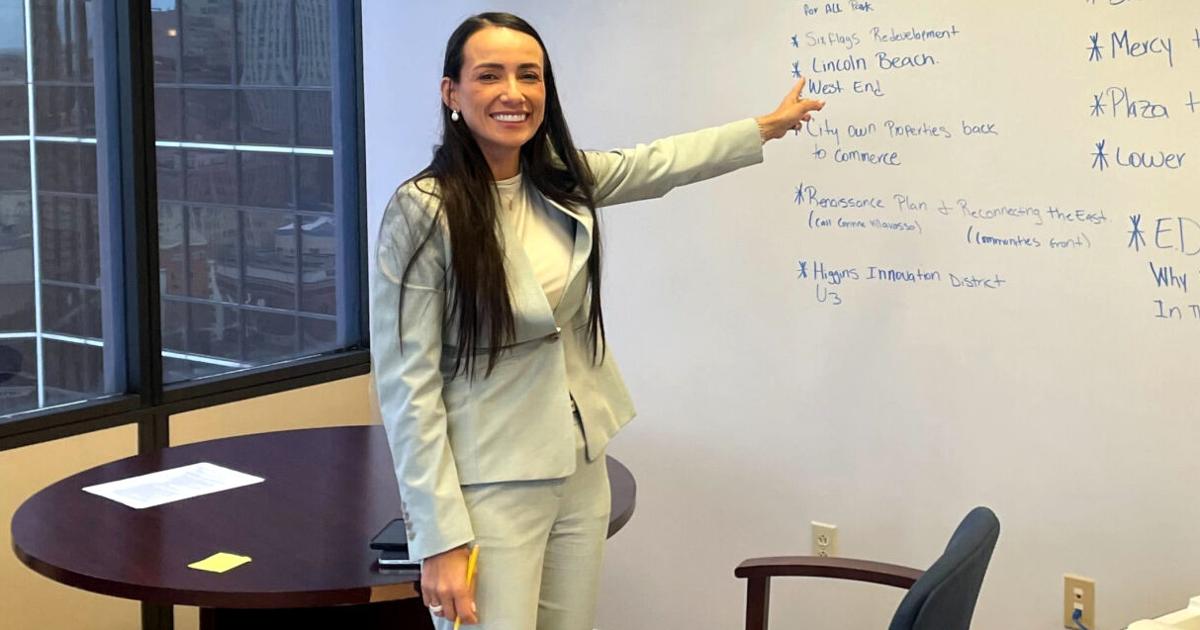
Jenny Mains’ path to becoming New Orleans’ deputy mayor for economic development was anything but direct.
Mains moved to Jefferson Parish in sixth grade and was raised by her Honduran grandparents. She has lived on her own since age 15, earning scholarships to become the first member of her family to graduate high school or attend college.
Fulfilling a childhood dream, she became a family practice physician and went on to work in community clinics in Honduras, El Salvador and Guatemala, where her experience stoked her interest in creating jobs. She didn’t want people to feel the need to leave their Central American home countries because of a lack of economic prospects.
Nearly a decade ago, she made a career shift, joining CRC Global Solutions, the Kenner-based logistics firm founded by her husband.
At CRC, Mains helped oversee the company’s international expansion and the doubling of its staff. She also spearheaded the growth of its nonprofit arm, CRC We Care, We Share, a volunteer operation that distributes as many as a dozen containers of food every week to places where CRC operates in the U.S. and abroad.
When Mayor Helena Moreno approached her about a role in City Hall, one of Mains’ conditions was that she be able to remain vice president of the nonprofit. Moreno said yes.
This interview has been edited for length and clarity.
Was it a difficult decision to accept the position as deputy mayor?
I never applied for it, and if you’d have asked a 10-year-old Jenny or a two-year-ago Jenny, I wouldn’t have believed it at all.
I know Mayor Moreno is a great leader. I love her integrity, I love her vision for the city, and I love her faith. A lot of her values really aligned with mine. I really appreciate that, because I can be anywhere I want in the world, but coming to work for somebody like her makes a lot of sense to me.
I had 21 questions that I was going to ask her, but I didn’t have to ask — she answered them without me asking. I told her I appreciate the opportunity, but I needed to pray on this. And she said, “Yes, take your time,” and I did.

Incoming deputy mayors Renee Lapeyrolerie, Jenny Mains and Charline Gipson laugh with Mayor-elect Helena Moreno during a press conference at the Great New Orleans Foundation in New Orleans, Friday, Jan. 9, 2026. (Photo by Sophia Germer, The Times-Picayune)
I felt God was telling me why I should, I felt that clear voice. And what was going on with my community around that time also really pushed me into showing the world that Hispanics are not what the media or some people say we are.
That gave me strength to walk into rooms where people who look like me are not usually in, and in order for me to shape my community and help my community, I had to be in those rooms.
What is a business advantage that we have here in New Orleans that isn’t present anywhere else?
First, we have strong cultural entrepreneurship. Historically, many of the city’s most successful businesses started as a small local venture that grew organically within the community.
Second, our geographic position is incredibly strategic.
We have one of the best airports here. We have the Mississippi River. We have the port. We have the rail. Just right there are four great things that any city would like to have.
And we rely a lot on our tourism industry, but we also have other industries that, if we’re able to grow them here, we’ll be able to create permanent, long-lasting jobs.
What industries present opportunities to boost during Moreno’s term?
Logistics will be something big, especially with the new port that’s coming to St. Bernard. We’re working really hard on making sure we’re not overpassed — that the road isn’t created without an exit to New Orleans, because if that happens, then we can forget about any businesses in New Orleans East.
That has been my No. 1 priority — looking at what they’re doing at a state level, what bridges are going to be built, what roads are going to be made — for us not to be left out.

A rendering of possible new road and rail links through the Central Wetlands system lakeside of Meraux in St. Bernard Parish, which are deemed necessary to alleviate congestion and accommodate thousands of trucks daily coming from the Port of New Orleans’ proposed Mississippi River container terminal at Violet.
We want to make sure that there’s an exit in New Orleans East, and with that, I believe it’s going to be a big boom in that area. We have to create an ecosystem. We can’t just go open one restaurant or one store and think that it’s just going to be back to before Katrina.
In my opinion, the anchor will be those distribution centers, then we will build that ecosystem of good, high-paying jobs — and not only jobs, careers.
What message do you have for people who have a hard time believing politicians or believing that the city government can really help them?
I would tell them, “Give us a chance.” And that there’s a scripture quote that says “By your fruits, you will be known.” I hope that in four years, they will know this administration, that it’s different, and that we’re going to be working really hard for the people of New Orleans and to create the city that we can all be proud of.
How would you define success in your role?
Success would be us really rebuilding those buildings that have been there since before Katrina, things that have been stopped for more than 20 years.
That would be successful, if we can get those projects open. And once those projects are open, that equals job opportunities, that equals economic stability for our people.