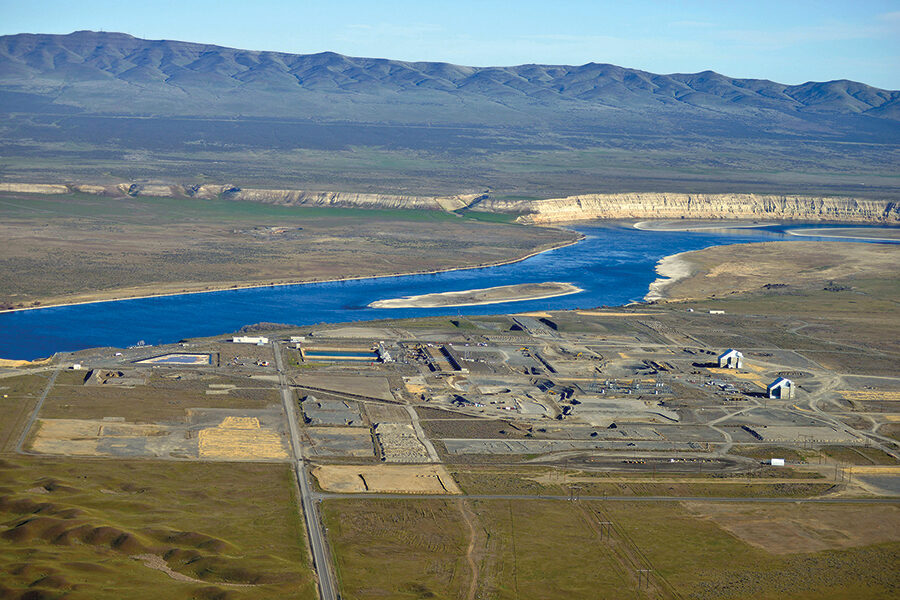
A year after requesting documents on plans to lease 19,000 acres of the Hanford site for clean energy development, a conservation group is asking a federal judge to force the U.S. Department of Energy to respond.
Columbia Riverkeeper filed its lawsuit June 17 in the U.S. District Court of Oregon, according to a release from the group.
The conservation group says there are numerous questions about everything from the potential of new nuclear development, delays in the cleanup effort at the site and lack of community engagement that need to be answered, and DOE has failed to produce a single document.
“When it comes to government transparency and the Hanford nuclear site, the stakes couldn’t be higher for people who rely on the Columbia,” said Simone Anter, senior attorney and Hanford program director for Columbia Riverkeeper, in a statement. “The public should not be kept in the dark about potential plans to redevelop an area where the U.S. government’s legally-binding mission is cleanup.”
The Hanford Office for DOE’s Office of Environmental Management did not immediately respond to a request for comment from the Tri-Cities Area Journal of Business.
DOE announced its “Cleanup to Clean Energy” initiative in the summer of 2023, identifying the Hanford site as one of five locations to participate.
The innovative effort is intended to repurpose parts of DOE-owned lands which were largely used to produce nuclear weapons and transform them into sites of clean-energy generation.
Agency officials said they would work with a diverse range of stakeholders, including industry, federal entities, tribes, state and local officials, to explore how up to 70,000 acres across the country could be built-out for utility-scale clean energy projects.
“We are going to transform the lands we have used over decades for nuclear security and environmental remediation by working closely with tribes and local communities together with partners in the private sector to build some of the largest clean energy projects in the world,” said then-Secretary of Energy Jennifer M. Granholm, in a statement. “Through the Cleanup to Clean Energy initiative, DOE will leverage areas that were previously used to protect our national security and will repurpose them to the same end — this time, generating clean energy that will help save the planet and protect our energy independence.”
In July 2024, Energy announced it was in negotiations with Hecate Energy LLC for a solar project capable of delivering up to 1 gigawatt of clean energy within an 8,000-acre area of the Hanford site as part of the initiative.
Columbia Riverkeeper filed a Freedom of Information Act (FOIA) request on June 24, 2024, for documents related to the DOE’s Request for Qualifications (“RFQ”), a public process whereby DOE sought proposals for projects, qualifications and offers related to the Cleanup to Clean Energy Initiative, according to court documents.
The requested records were likely to contain proposals, responses, names of respondents to the RFQ, and related documents identifying the types of energy projects being considered by DOE.
“The information contained in these documents will allow Columbia Riverkeeper, its members, and the public to assess the potential plans for the Hanford site and to determine whether those plans are in alignment with the cleanup requirements of CERCLA and other applicable environmental statutes,” read the conservation group’s complaint, adding “The public has a right to know about the government’s rationale for making decisions related to Hanford cleanup.”
Federal agencies are required to provide an initial response to FOIA requests within 20 days, including whether they would comply with the request. Columbia Riverkeeper and DOE did exchange communications for months to refine the request but with no determination that DOE would provide records.
Columbia Riverkeeper says in court documents that it filed an appeal for DOE’s lack of substantive response to its request.
Two months later, DOE dismissed that appeal, saying the conservation group lacked jurisdiction and noted in a letter that “since it had not ‘issued a final determination’ on the FOIA request ‘within the statutory time limit,’ Columbia Riverkeeper ‘may be deemed to have exhausted (its) administrative remedies and may proceed with this matter in federal district court.’”
“FOIA requires transparency from our federal agencies, and it codifies a national policy in favor of disclosure of government records,” said Jamie Saul, executive director of Wild & Scenic Law Center, who is representing Columbia Riverkeeper in this case, in a statement. “Energy’s unlawful delay in responding to Columbia Riverkeeper’s valid FOIA request undermines that policy and prevents the public from learning about important government decisions related to the Hanford site.”
Columbia Riverkeeper isn’t the only entity with concerns about DOE’s clean energy efforts. While there were constructive conversations between DOE and local governments and stakeholders on the initiative, some have said more progress is needed.
“We have been concerned DOE’s initial approach could disincentivize such investment opportunities and could potentially harm the community’s ability to build a diversified post-Hanford cleanup economy for the future,” said Sean O’Brien, executive director of Energy Forward Alliance, in the June 2024 edition of the Journal, noting that a coalition of community partners has urged DOE to consider its proposal to lease or transfer some, if not all, of the 14,000 acres to the community to be master-planned for development.
The alliance is a nonprofit subsidiary of the Tri-City Development Council, or TRIDEC.