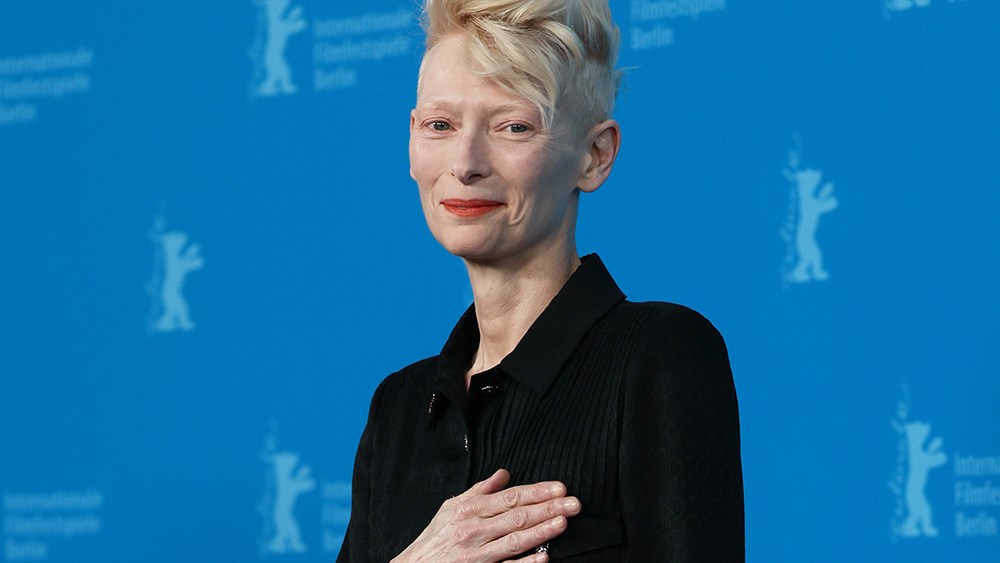
Tilda Swinton spoke about her decision to attend Berlin Film Festival despite calls for a boycott over the war in Gaza, saying it was “more useful to our causes” for her to show up.
On Thursday night, the Oscar winner received the festival’s honorary Golden Bear and made an impassioned speech in which she called out the “state-perpetrated and internationally-enabled mass murder is currently actively terrorizing more than one part of our world.”
During a press conference on Friday, Swinton — who has been a longtime advocate for Palestinians — was asked about the BDS Movement‘s call for a boycott of the festival over the treatment of filmmakers who spoke out against the war in Gaza at last year’s closing ceremony.
“I’m a great admirer of and have a great deal of respect for BDS and I think about it a lot,” Swinton said. “I am here today — and yesterday and tomorrow and the next day — because I decided to come, I decided it was more important for me to come. I was given, thanks to the festival, a platform which I decided in a personal moment was potentially more useful to all our causes than me not turning up. It was a judgment, and a personal judgment call, that I take full responsibility for.”
However, Swinton added that she has “enormous respect and understanding for the need for people to find ways of feeling powerful. Because what we’re all up against is this feeling of powerlessness and this is, in a way, the most difficult thing we’re all having to deal with right now. And so any powerful action, gesture we can make feels like a good option. I understand absolutely that boycotting can feel and very often is the most powerful thing we can do.”
In her speech on Thursday night, Swinton lauded the festival as “a borderless realm with no policy of exclusion, persecution or deportation.” The “great independent state of cinema,” Swinton added, is “innately inclusive — immune to efforts of occupation, colonization, takeover, ownership or the development of riviera property.
“The inhumane is being perpetrated on our watch,” she continued. “I’m here to name it without hesitation or doubt in my mind and to lend my unwavering solidarity to all those who recognize the unacceptable complacency of our greed-addicted governments who make nice with planet-wreckers and war criminals, wherever they come from.”
Elsewhere during the press conference, Swinton revealed that after she leaves the festival next week, she’s “entering something that I’ve been looking forward to for 15 years, which is a period of my life where I do something different.”
“I can’t quite say what it is, but I can say I’m not shooting a film for the rest of this year,” she continued. “I want more time, I want time to develop projects — some are in cinema, some are not — but I need time. And as you know, filmmaking is a merciless mistress and I’ve been under the lash for a while.”
Swinton added that since COVID-19 caused a lull in production, “things have gotten a little crazy.”
“That feeling of smash and grab and insecurity about finance has been really strenuous for us all,” she sad. “I need a break, so I’m going to have one. I’m going to have some peace and quiet and figure out what the next 40 years are.”
Swinton has had close ties to the Berlinale for nearly four decades, starring in 26 films in the festival’s selection including “Caravaggio,” which won the Silver Bear in 1986; “The Beach” (2000); “Derek” (2008); “Julia” (2008); “The Garden” (1991); and “Last and First Men” (2020). She also presided over the Berlinale’s main jury in 2009.